


Walk onto the assembly floor of an AGV manufacturer still using a discrete drive architecture, and the complexity becomes easy to see. A servo drive is mounted to one side of the chassis. A motor is bolted to the wheel assembly.
Cables snake between them—power cables, feedback cables, communication cables. Each component requires its own bracket. Each connection must be routed, secured, and tested.
This approach has been the industry norm for years. But as AGV production scales and vehicle designs grow more compact, the limitations of discrete architectures are becoming harder to ignore.
More manufacturers are exploring an alternative: integrated drive modules that combine the drive, motor, reducer, and wheel into a single assembly.
The Assembly Complexity of Discrete Drive Architectures
The most immediate difference between discrete and integrated architectures is visible on the assembly line. With discrete components, a technician handles four separate units, each with its own mounting requirements and cable connections.
The assembly process involves multiple steps: mounting the drive, mounting the motor, aligning the motor with the reducer, attaching the wheel, routing cables, and verifying each connection.
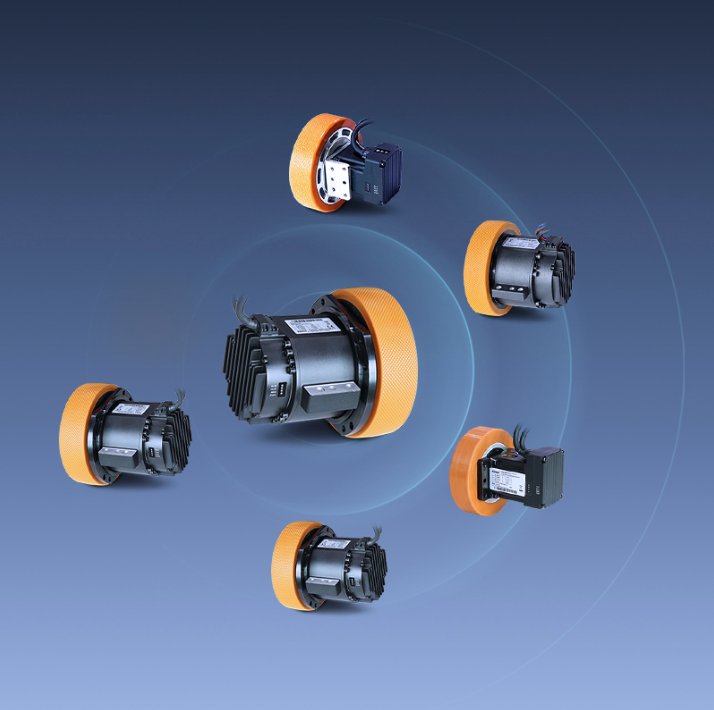
Our iWMC integrated servo wheel combines the servo driver, servo motor, high-precision planetary reducer, and polyurethane wheel into a single unit. The optimized installation structure enables faster installation and shortens overall vehicle assembly time. In one Kinco application, the integrated approach reduced installation hours by more than 80% compared with the previous configuration using discrete components.
Eighty percent is not an incremental improvement. For a manufacturer producing thousands of AGVs annually, this type of reduction translates directly into lower labor costs and the ability to scale production without proportionally increasing assembly headcount.
Space Efficiency Drives Design Decisions
AGV designs are getting smaller, not larger. Warehouse aisles are narrowing. Payload capacity requirements are rising while overall vehicle footprints are shrinking. Every cubic centimeter inside the chassis must justify its existence.
Discrete-component architectures consume space in ways that are difficult to optimize. The drive needs a mounting surface and clearance around it. The motor needs clearance for cooling and cable access. Each component demands its own envelope, and the gaps between them are effectively wasted space.
By combining four major components into one compact unit, an integrated drive module can save approximately 35% of installation space compared to a typical discrete configuration. For a vehicle designer, that 35% opens possibilities: a larger battery pack, a more capable onboard controller, or a slimmer overall profile that fits into tighter warehouse environments.
Our iWMC series demonstrates this space efficiency across different payload capacities. The 50kg-load model has a wheel diameter of 150mm and a length of 135mm, enabling AGV designs that match standard tote dimensions. The 200kg and 350kg models provide higher load capacities while maintaining similar packaging efficiency.
Fewer Connections, Fewer Failure Points
For the AGV drive wheel, every cable is a potential failure point. Every connector is a potential source of intermittent faults. Every mounting interface must withstand vibration, thermal cycling, and the occasional physical shock that comes with warehouse operations.
The arithmetic is straightforward. A discrete drive system requires multiple cable connections: between drive and motor, between motor and encoder, between drive and power supply, and between drive and controller. An integrated drive module significantly reduces external connections—typically just power and communication cables.
By shortening interconnections and reducing the number of external connectors, an integrated module can reduce some of the wiring-related failure and EMI risks associated with distributed architectures.
This is particularly relevant for AGVs, where cable routing paths often run close to other systems that generate electrical noise. Fewer cables mean fewer potential antennae and fewer opportunities for noise coupling.
For AGV manufacturers, this translates into lower field failure rates and reduced warranty claims over the vehicle's operational lifetime. The practical benefit is not theoretical—it shows up in maintenance records and customer satisfaction scores.
The Total Cost Calculation
The unit price of an integrated drive module is higher than the sum of its individual components—at first glance. This is where procurement teams often stop the analysis, concluding that discrete components are more cost-effective.
That comparison misses the full cost picture. The integrated module arrives pre-assembled, pre-tested, and pre-tuned. The discrete components arrive separately and must be assembled, aligned, and commissioned on the manufacturer's assembly line. Assembly time has a cost.
Engineering time for designing brackets and cable routing has a cost. Inventory carrying cost for four separate SKUs has a cost. Quality control effort for verifying each connection has a cost.
When these factors are included, the total cost of ownership often favors integration. Kinco's iWMC series was developed specifically to address the mobile robot market's core demands of cost reduction, quality assurance, and efficiency improvement. The optimization of reducer design and the use of integrated connectors help reduce overall servo wheel costs, making the integrated approach economically compelling even before the assembly savings are fully factored in.
Supply Chain Simplification
There is a less visible but equally practical advantage to integrated drive modules: supply chain simplification.
A discrete drive system requires sourcing from multiple suppliers. The drive comes from one vendor, the motor from another, the reducer from a third, the wheel from a fourth. Each supplier has its own lead times, quality standards, and minimum order quantities. Coordinating across this supply chain consumes procurement resources and introduces scheduling risk.
An integrated drive module consolidates these components into a single supply line. One supplier. One purchase order. One quality inspection. One warranty contact. For AGV manufacturers managing dozens or hundreds of component SKUs, this simplification is not a minor convenience—it reduces overhead and accelerates production ramp-up.
The iWMC series also addresses delivery timelines directly. By reducing cable assembly processes during production, the module simplifies manufacturing flow and improves delivery efficiency. Faster delivery means shorter lead times for AGV manufacturers, which translates into faster response to customer orders.
When Does Integration Make the Most Sense?
Integrated drive modules are not the right choice for every AGV application. Understanding where they fit—and where discrete architectures still have advantages—helps manufacturers make informed decisions.
Integration makes the most sense for manufacturers with high production volumes, where assembly time savings compound across thousands of units. It also fits applications with tight space constraints, where every millimeter of saved space contributes to vehicle performance. And it is particularly valuable for manufacturers who want to simplify their supply chain and reduce component count.
Discrete architectures may still be preferable for low-volume, highly customized AGVs where each vehicle has unique drive requirements. They also offer more flexibility for swapping individual components when specifications change.
For most volume AGV manufacturers, however, the trend is clear. Integrated drive modules that combine the motor, gearbox, and AGV drive wheel reduce assembly time, save space, improve reliability, lower total cost, and simplify supply chains.
At Kinco, the iWMC series represents our response to what manufacturers are telling us they need: fewer parts, less assembly, more reliable operation, and faster time to market.


