


For years, motion control engineers faced a straightforward choice when designing an automated guided vehicle: select a servo motor, pair it with a gearbox, mount a wheel, and wire it all together.
The servo motor delivered torque; the gearbox amplified it; the wheel provided traction. Each component came from a different supplier, arrived in separate boxes, and demanded its own installation procedure. That was the accepted cost of doing business.
But the question that keeps coming up in design reviews is no longer simply "which servo motor should I use?" It is "why are we still building AGV wheels from loose parts when integrated alternatives exist?"
For many AGV applications, the distinction between a standalone servo system and a purpose-built drive wheel is becoming less relevant—not because servos have lost their value, but because integrated architectures address real-world constraints that separate components cannot.
The Hidden Costs of the Traditional Split Architecture
A conventional AGV motion system separates the servo motor, gearbox, wheel, and driver into individual components. On paper, this offers flexibility—you can mix and match brands to hit specific torque or speed targets. In practice, the trade-offs accumulate quickly.
Wiring complexity is the first problem. Each component requires its own power and signal cables. The servo driver needs communication lines back to the controller. The motor needs feedback cables for the encoder. The brake, if present, adds another circuit. By the time everything is connected, a single drive axis can consume significant cabinet space and introduce multiple failure points.
Installation time follows the same pattern. Mount the motor. Align the gearbox. Attach the wheel. Secure the driver. Route the cables. Each step requires mechanical alignment, torque verification, and clearance checks. For a vehicle with two or four drive wheels, the cumulative labour hours are substantial.
System reliability suffers from the fragmentation. With more connectors, more cables, and more separate enclosures, the probability of loose connections or environmental ingress increases. Traditional split-drive architectures also face challenges with total cost of ownership, long lead times, insufficient protection levels, and limited cable outlet directions.
When Integration Becomes the Practical Choice
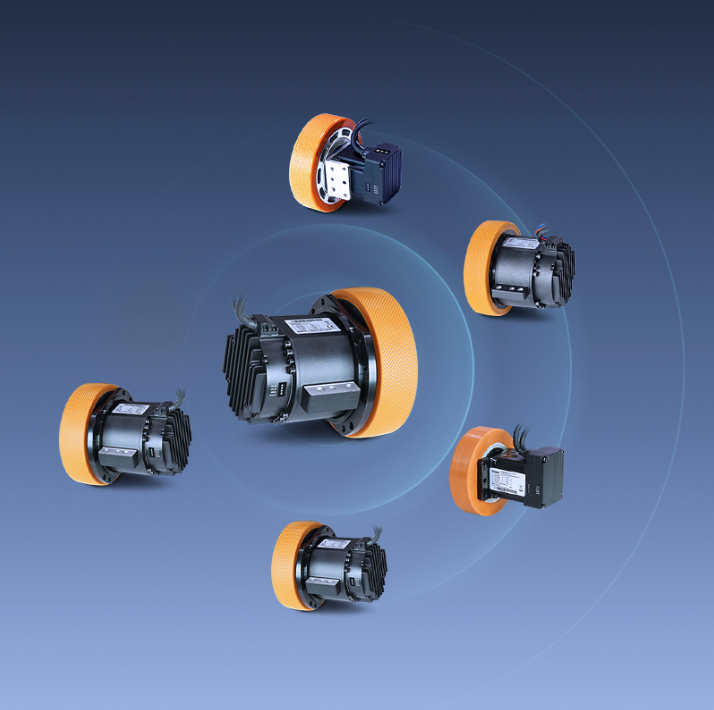
Our iWMC integrated servo wheel demonstrates what happens when you rethink the architecture from the ground up. Instead of four separate components, it combines the servo driver, servo motor, high-precision planetary gearbox, and polyurethane tire into a single, compact assembly.
This is not a servo motor with a wheel bolted onto it. The integration changes the entire system architecture. Power and communication cables are the only connections required. The driver communicates via standard CANopen or Modbus, following the CANopen 2.0A/B protocol. A built-in temperature sensor monitors internal conditions and provides early warning of abnormalities, ensuring safe AGV operation.
The load capacity is substantial for most warehouse and material-handling vehicles. A single iWMC unit can support AGVs up to 1,000 kg in a two-wheel-drive configuration, while the 180mm wheel model reaches a rated linear speed of 2.14 m/s.
This combination is particularly relevant for warehouse AMRs and material-handling vehicles where payload capacity and chassis space must be balanced. The integrated design saves approximately 35% of installation space compared to traditional split architectures.
Where the Modular Approach Still Wins
The decision between a standalone servo motor and an integrated AGV wheel is not a matter of one being universally superior. Each approach has a domain where it makes more sense.
The modular servo approach remains valuable when you need extreme customisation. If your vehicle requires a non-standard gear ratio, an unusual motor winding, or a specialized tire compound that no integrated product offers, building from separate components is the only path forward. Similarly, if your AGV exceeds the 1,000 kg load range or demands a wheel diameter outside the standard offering, a modular design provides the necessary flexibility.
The integrated approach, by contrast, excels in standardised vehicle platforms. For AGVs up to 1,000 kg with two drive wheels, integrated solutions offer proven performance with significantly reduced engineering overhead.
The trade-offs between motor, gearbox, and wheel are already resolved inside the housing. The driver is pre-tuned for the specific combination. Mechanical alignment is factory-set. What you lose in component-level flexibility, you gain in installation speed, wiring simplicity, and overall system reliability.
This is why the distinction between servos and drive wheels is fading in specific contexts—not because servos are obsolete, but because integration addresses the practical constraints that matter most in mass-produced AGV platforms.
Three Questions to Guide Your Decision
The choice between a standalone servo motor and an integrated AGV drive wheel comes down to three practical questions.
First, what is your vehicle's load class? For AGVs up to 1,000 kg with two drive wheels, integrated designs offer a proven, space-efficient solution. For heavier loads or non-standard configurations, a modular approach remains necessary.
Second, how much installation space and engineering time can you dedicate to each drive axis? Integrated designs save approximately 35% of installation space and eliminate alignment, tuning, and separate driver mounting. If your production timeline is tight or your engineering resources are limited, the integrated path becomes more attractive.
Third, what is your tolerance for supply chain fragmentation? A modular system requires coordinating deliveries from multiple suppliers and managing compatibility across components. An integrated system arrives as a single unit with a single part number. For high-volume vehicle manufacturers, this simplification reduces procurement complexity and inventory overhead.
Rethinking Motion Architecture for AGVs
We designed the iWMC series around these practical considerations. The four-in-one integration solves the pain points that modular systems create: complex wiring, cumbersome installation, large space occupation, and lower system reliability. The result is a motion component that behaves less like a collection of parts and more like a unified subsystem.
For AGV manufacturers, the more important question is no longer simply which motor to select, but how to build a motion system that is compact, reliable, and easier to deploy. Integrated AGV drive wheels address that challenge by treating the motor, drive, gearbox, and wheel as one motion subsystem. Kinco has focused on making that subsystem work seamlessly across the vehicle classes where integration delivers the greatest return.
The standalone servo approach still has its place for heavy-duty, highly customised vehicles. But for the majority of warehouse AMRs and material-handling AGVs in the 600–1,000 kg range, the integrated wheel offers a simpler, faster, and more reliable path to deployment.
That is not a claim that servos are obsolete—it is an acknowledgment that the architecture of the drive system matters as much as the components within it.


