


Frameless torque motors have become a common specification in advanced robotics, but their name often creates confusion. The term suggests something incomplete. In reality, a frameless torque motor is stripped of everything that does not contribute to motion — the housing, bearings, shafts, and end caps are removed, leaving only the electromagnetic core: the stator and rotor.
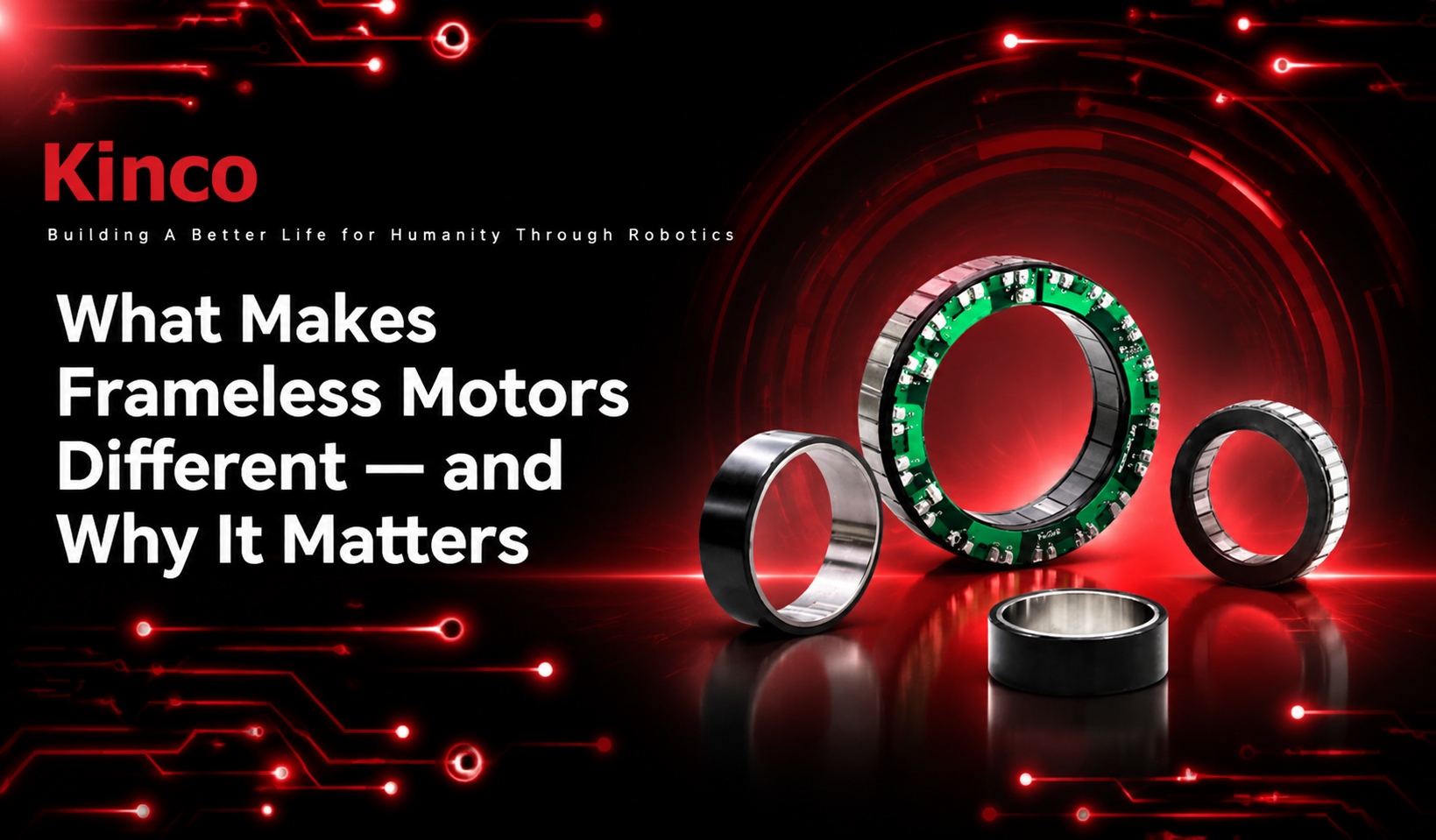
What remains is a compact, high-performance torque generator designed to be embedded directly into a mechanical structure.
This design choice changes what a motor can do. Here is what defines frameless motors and why those features matter.
What a Frameless Motor Actually Is
Understanding the benefits starts with understanding what a frameless motor is not. A conventional servo motor comes as a complete, sealed package. The motor manufacturer provides the housing, bearings, output shaft, feedback device, and connectors — all assembled and tested as a unit.
A frameless motor kit supplies only the stator and rotor. The rest — the structural support, bearings, shaft, and thermal management — is designed directly into the application. This is not a cost-cutting measure. It is a deliberate engineering choice that gives system designers control over how the motor integrates with the rest of the mechanism.
For robotic joints, this means the motor becomes part of the joint structure rather than an add-on component. The joint housing provides the structural support. The output shaft is the joint axis. The bearings are shared with the rest of the rotation system. The result is a more efficient use of space and materials.
High Torque Density in a Compact Footprint
The defining performance advantage of a frameless motor is torque density — the amount of torque produced per unit of volume or weight. By eliminating the housing and other non-functional structures, frameless motors pack more electromagnetic material into a given space.
With the FMK series, we demonstrate what this looks like in practice. The motor platform achieves high torque density within a compact footprint, delivering stable, high continuous power output in minimal installation space. The torque ratings across the series range from 0.063 N·m continuous to 3.5 N·m continuous, with peak torque reaching up to 11.5 N·m. These numbers come from motors with outer diameters ranging from just 25mm to 115mm.
For a robot designer, the implication is straightforward: a smaller, lighter motor can produce the torque needed for a given joint, leaving more payload capacity for the rest of the system. This is particularly valuable in humanoid and legged robots, where every gram of motor weight directly affects walking efficiency and battery life.
The Hollow Design Advantage
One feature that distinguishes modern frameless motors from earlier generations is the hollow bore design. The FMK series uses a large-ratio hollow design with enlarged rotor inner diameters. This is not a cosmetic detail — it directly addresses a practical problem in robotic joint design: cable routing.
In a typical robotic joint, power cables, signal wires, and sometimes fluid lines must pass through the joint axis. With a solid-shaft motor, those cables must be routed around the outside of the motor, consuming additional space and creating potential pinch points during rotation. A hollow motor allows cables to pass directly through the center of the motor, following the natural axis of rotation.
The FMK series offers outer diameters in eight standard sizes from 25mm to 115mm, with the hollow bore proportion increasing with size. This design simplifies mechanical integration, reduces the overall joint length, and eliminates the cable management challenges that often plague compact robotic designs.
Thermal Performance That Enables Continuous Operation
Heat is the enemy of motor performance. As temperature rises, winding resistance increases, magnets lose strength, and bearing life shortens. For robots operating continuously — in manufacturing, logistics, or service applications — thermal management is a critical factor in long-term reliability.
Our FMK series addresses this through optimized stator welding and potting processes that reduce weight while lowering temperature rise. The platform achieves suppressed thermal rise for long-duration continuous operation. This is not just about keeping the motor cool — it is about maintaining consistent torque output over extended run times.
Lower temperature rise also means the motor can operate at higher continuous torque levels without exceeding thermal limits. For a robot performing repetitive tasks over an eight-hour shift, this translates to consistent performance from start to finish, rather than gradual torque derating as the motor warms up.
Dynamic Response for Agile Motion
Robotic joints require rapid acceleration and deceleration, precise positioning, and smooth motion at low speeds. These demands place a premium on the motor's dynamic response — how quickly it can change speed or direction in response to a control signal.
Frameless motors offer inherent advantages in this area. The absence of a separate housing and output shaft reduces the total rotating inertia that the motor must accelerate. Lower inertia means faster acceleration and deceleration, which translates to shorter cycle times and more responsive motion.
The mechanical time constant — a measure of how quickly the motor accelerates to rated speed — ranges from 0.583 ms to 1.947 ms across the FMK series. These low values indicate that the motor can change speed rapidly, which is essential for applications requiring agile, coordinated multi-joint movement.
Design Flexibility Across Robot Types
Frameless motors are not limited to a single application. The FMK series is designed to support humanoid, collaborative, and quadruped robot joints, covering everything from the waist and shoulders to elbows and wrists. The platform can support both rotary joints and linear joints required for a full set of full-size humanoid robots.
The series also supports customization. Beyond the eight standard frame sizes, the Kinco FMK platform offers full-process personalized customization services to match different application requirements.
This means a system integrator can specify a motor that fits the exact mechanical envelope of a given joint design, rather than designing around a standard off-the-shelf motor.
The Frameless Difference
Frameless motors are not a niche product for exotic applications. They are a practical response to the space, weight, and performance constraints that define modern robotics.
By removing everything except the electromagnetic core, they deliver higher torque density in less space, enable cleaner mechanical integration through hollow designs, run cooler under continuous load, and respond faster to control inputs.
These are not incremental improvements. They are the kinds of changes that make new robot architectures possible — slimmer limbs, lighter chassis, longer operating times, and more dexterous movement. For engineers designing the next generation of robotic systems, that is the difference that matters.


