


When we talk about robotic efficiency, the conversation often starts with cycle time. But in our experience designing motion control systems for robots across logistics, manufacturing, and humanoid applications, speed is only part of the picture.
True robotic efficiency is measured in how well a robot converts power into productive work, how reliably it repeats that work over thousands of cycles, and how little time and resources are consumed keeping it running. In industrial automation solutions, motion control touches every one of these dimensions. Here is how.
Integration and the Space-Time Efficiency Trade
The most direct way motion control improves robotic efficiency is through hardware integration. A robot with separately mounted motors, drivers, controllers, and cabling consumes more physical space, takes longer to assemble, and offers more points of failure. We have seen this play out repeatedly in mobile robot deployments.
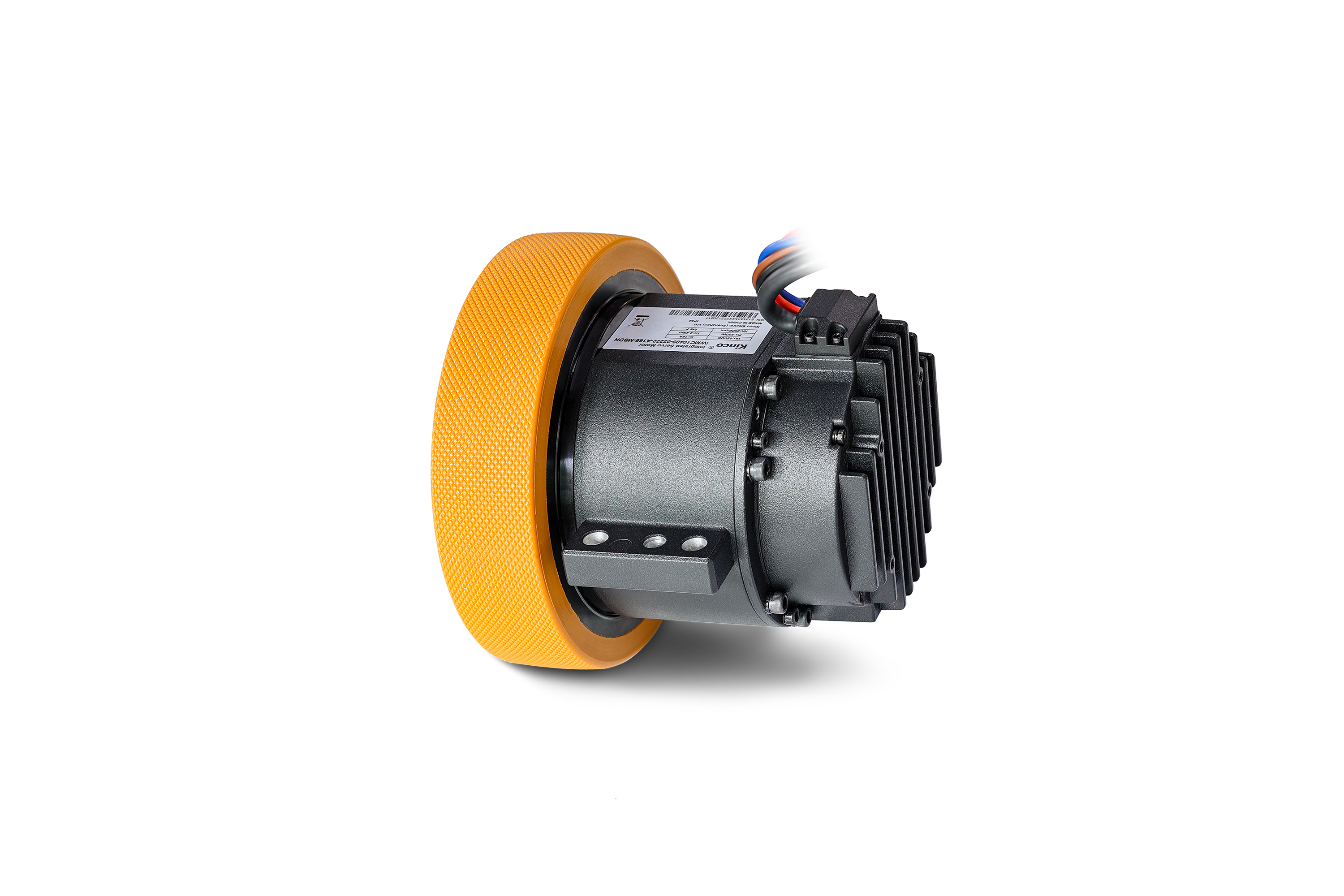
Take our iWMC integrated servo wheel. By combining drive, motor, reducer, and tire into a single module, it saves over 35% of installation space for walking driver components. For under-vehicle mobile robots — the kind that operate in tight warehouse aisles — the benefit extends beyond footprint reduction.
The iSWV omnidirectional steering wheel module integrates driving and steering into one system, enabling lateral translation and flexible steering while lowering vehicle height, drastically improving maneuverability in narrow spaces.
What does this mean for robotic efficiency? Less time on the assembly floor. Less engineering effort spent on routing cables and matching components. More robots deployed faster, with fewer integration errors. This approach extends beyond wheels.
Our FMK series frameless torque motors feature a large hollow design that reduces total module length by 40%, giving mechanical engineers flexible room to route bearings and cables. The RD series hollow driver, with a 20mm hollow diameter, helps simplify cable routing within compact robotic joints. When every millimeter counts in a robotic joint, this kind of integration directly improves both mechanical and assembly efficiency.
Algorithms That Cut Energy Waste
Robotic efficiency is not just about how fast a robot moves — it is about how much energy it uses to do so. Motion control algorithms determine the relationship between electrical input and mechanical output, directly affecting robot energy consumption.
One example is the MTPA (Maximum Torque Per Ampere) motor control strategy. By reducing copper loss and improving motor efficiency, this approach lowers temperature rise and system energy consumption, achieving up to 51% in power savings.
For robots operating around the clock in warehouses or manufacturing lines, that reduction translates directly to lower operating costs and extended component life. This is what we mean when we talk about robotic energy efficiency — not just moving, but moving with minimum waste.
Thermal management is another overlooked efficiency factor. Robots running at elevated temperatures experience increased winding resistance, reduced torque output, and shorter bearing life.
Our fourth-generation FMK frameless torque motors use optimized stator welding and potting processes to reduce weight while lowering temperature rise, effectively solving the heat dissipation pain point of legged robots during long-term operation. Lower temperature means less energy wasted as heat and more available for productive work, directly improving servo motor efficiency.
Synchronization and Cycle Consistency
A robot with multiple axes that cannot coordinate precisely is an inefficient robot. Robotic motion control systems that support high-speed fieldbus communication enable true multi-axis synchronization, eliminating the delays and inaccuracies that come with decentralized control.
Our FM series bus stepper drivers support CANopen, Modbus, and RS232 communication. The AK series motion controllers support up to 32 axes of EtherCAT synchronous motion control.
For flying box robots operating at high speeds in conveying systems, our integrated fieldbus motion controller paired with all-in-one drive modules enables multi-axis virtual master synchronous motion control.
The efficiency gain here goes beyond trajectory quality. Better synchronization does not only improve path accuracy — it also reduces unnecessary correction movements and helps maintain consistent cycle times.
When axes move in precise coordination, there is no wasted motion, no corrective repositioning, and no cumulative error. The robot completes its task in fewer movements, with higher first-pass quality. This is multi-axis motion control at its most effective: turning coordination into throughput.
Efficiency Across the Robot’s Lifecycle
Robotic efficiency is also measured in how quickly a system can be deployed and how easily it can be maintained. Motion control solutions that reduce engineering overhead improve overall project efficiency — not just on day one, but across the entire lifecycle of the equipment.
The Kinco FD5P-Pro servo system, for example, uses intelligent tuning and adaptive algorithms to significantly lower the application threshold. Its load inertia auto-identification and one-click parameter tuning shorten project delivery cycles and improve engineering efficiency. High synchronization accuracy and strong anti-interference capability reduce unplanned downtime, improving overall equipment effectiveness.
Modular architectures also play a role. By using standardized integrated modules — servo wheels, rotary lifting modules, forklift controllers — system integrators can reduce development cycles and production costs. Instead of designing motion systems from scratch for each new robot platform, engineers can select pre-validated modules that are ready to deploy.
This approach also simplifies spare parts management and field replacement, since the same modules work across multiple robot models. When a robot goes down, getting it back online quickly is just as important as keeping it running in the first place.
Efficiency in Four Dimensions
When we look at how motion control improves robotic efficiency, we see four distinct mechanisms at work. Hardware integration reduces space and assembly time. Control algorithms optimize energy conversion and thermal performance. Communication architecture enables precise multi-axis coordination. And system-level design choices reduce deployment and maintenance overhead.
Each mechanism addresses a different bottleneck. Together, they define what efficient robotic systems really mean — not just moving fast, but moving smart, wasting less, and lasting longer. That is the standard we build toward, and it is the standard that makes the difference between a robot that merely works and one that works efficiently.


