


Ask a dozen automation engineers to define “robot,” and you will receive a dozen different answers. One describes a six‑axis arm welding car frames. Another pictures an autonomous mobile platform shuttling pallets. A third sketches a bipedal humanoid climbing stairs. This diversity is exciting, but it makes component selection deceptively difficult.
The most common mistake is to search for a single “robotic” servo drive or controller that fits everything. That approach rarely works. The motion control needs of a quadruped robot have almost nothing in common with those of a collaborative arm. The selection process must begin with a clear answer to one question: what kind of robot are we actually building?
The First Filter: Robot Morphology Defines the Requirements
Robotics has splintered into distinct families, each with its own mechanical constraints, power budgets, and performance priorities. A humanoid robot demands extreme torque density within a tiny joint envelope. A mobile robot prioritises energy efficiency and a compact propulsion system. An industrial arm values absolute positioning accuracy and tight synchronisation across multiple axes.
These differences are not cosmetic. They dictate the motor technology, the communication protocol, the voltage level, and even the physical mounting format. Fortunately, the product landscape has matured to match this diversity. The real task is mapping the robot type to the right product family.
For instance, the integrated motor‑drive combinations that work beautifully in a mobile robot would be overkill for a simple indexing table, but they are essential when every gram counts.
Humanoid and Legged Robots: The Joint‑Space Challenge
Humanoid, bipedal, and quadruped robots share a fundamental mechanical bottleneck: each active joint must generate high torque while occupying minimal space and adding negligible weight to the limb. Conventional separate motors and external drives are impractical here—they consume too much room and introduce cable management nightmares.
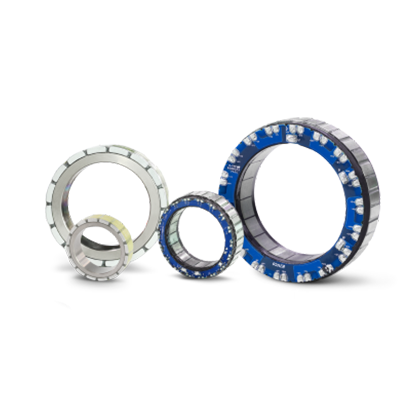
The preferred solution is a highly integrated joint module that combines the motor, drive electronics, and often a harmonic reducer into a single cylindrical package. Frameless torque motors are particularly attractive because they eliminate the extra housing and bearings of a standard framed motor, allowing direct integration into the joint structure. Different joint sizes—from finger joints to hip joints—require different torque and diameter specifications.
For teams that want a ready‑to‑integrate joint, pre‑assembled joint modules reduce development risk significantly. The mechanical design, thermal dissipation, and EMC shielding have already been validated. Engineers can concentrate on kinematics and control algorithms rather than wrestling with component fit.
Another critical factor for legged robots is the power source. Most of these platforms run on batteries, so low‑voltage servo systems operating at DC48V or DC96V are the natural choice.
These drives match typical battery architectures and eliminate the need for bulky AC‑to‑DC conversion on board. When selecting industrial automation solutions for humanoid projects, always check the voltage compatibility first—it automatically filters out many AC‑only products.
Mobile Robots: Propulsion, Efficiency, and Integrated Drive Modules
Autonomous guided vehicles (AGVs), automated forklifts, shuttle cars, and warehouse AMRs have a completely different set of priorities. These robots need to move efficiently over long distances, navigate tight aisles, and run for full shifts on battery charge. The motion control system must provide propulsion, steering, and sometimes lifting, all while consuming as little energy as possible.
The strongest trend in this segment is the move toward fully integrated drive modules. A single assembly that combines the motor, gearbox, drive electronics, and wheel saves substantial installation space and dramatically reduces cabling and assembly time. For a mobile robot with four or six drive wheels, the cumulative benefit in build time and panel space is hard to ignore.
Omnidirectional platforms add another layer of complexity—they require steering in addition to propulsion. Integrated steering wheel modules that handle both functions in one compact unit simplify the mechanical design and reduce the number of separate components. This kind of integration is a hallmark of modern industrial automation solutions for logistics robotics.
Forklift‑style automated vehicles have their own specialised needs. A dedicated forklift controller that manages both driving and lifting functions delivers better optimisation than a general‑purpose servo drive. These controllers include specific motion profiles for pallet handling, such as smooth acceleration and deceleration during lifting, which reduces load swing and improves safety.
Energy efficiency is not a secondary concern—it is a primary selection criterion. Low‑voltage servo systems at DC48V or DC96V are standard because they align with common lithium‑battery packs. Some integrated servo motors also include built‑in holding brakes, which are essential for mobile robots that stop on inclines or need to hold position without consuming power.
Collaborative and Industrial Arms: Precision, Synchronisation, and Safety
Fixed‑base articulated robots—whether collaborative (cobots) or traditional industrial arms—represent the more classical robotics domain. They share the humanoid robot’s need for compact joint modules, but they add stringent requirements for absolute repeatability, path accuracy, and multi‑axis synchronisation.
The motion controller becomes the nerve centre of these systems. For a six‑axis arm, the controller must coordinate all joints with sub‑millisecond cycle times, executing electronic gearing, cam profiles, and interpolated moves simultaneously. High‑performance controllers with multi‑core processors and dedicated EtherCAT interfaces are well‑suited to this task. The controller selection directly influences the achievable cycle time and trajectory smoothness.
For smaller collaborative arms or space‑constrained installations, compact flat controllers that mount inside the robot base or a small control cabinet are gaining popularity. They offer the same core motion capabilities in a footprint that fits tight enclosures.
Communication architecture is non‑negotiable in multi‑axis arms. EtherCAT has become the dominant protocol because it provides deterministic, low‑latency synchronisation across all axes.
Servo drives that natively support EtherCAT, along with Modbus for auxiliary devices, enable seamless integration with the motion controller. When evaluating motion control products for articulated robots, always verify that the drives and the controller speak the same fieldbus language.
Safety is equally critical, especially for cobots that work alongside humans. Servo drives with integrated STO (Safe Torque Off) function allow the system to safely cut torque to specific joints without powering down the entire cabinet. This feature is often a regulatory requirement for collaborative applications, so it should be included in the selection checklist from the start.
A Universal Decision Framework That Works for Any Robot
Despite the diversity of robot types, a simple three‑question framework can guide most selection decisions.
First, what is the primary power source? Battery‑powered robots point to low‑voltage servo systems (DC48V or DC96V). Line‑powered industrial arms can use standard AC servo drives. This single filter eliminates a large portion of the catalogue immediately.
Second, how many axes require coordinated motion? A two‑wheel differential mobile robot has minimal synchronisation needs. A six‑axis arm demands tight coordination across all joints. The motion controller choice—from a basic pulse‑direction controller to a high‑end EtherCAT master—flows directly from this answer.
Third, where will the drive electronics be located? Distributed architectures, where drives are embedded inside the joints, call for integrated motor‑drive combinations. Centralised cabinet architectures can use separate drives and motors with standard cabling. The physical layout of the robot determines which form factor is practical.
Beyond these questions, always consider the total ecosystem. Does the HMI, the PLC, and the motion controller share the same protocol? Is the debugging software intuitive enough for your team?
At Kinco, we have designed our robotics portfolio to span these different morphologies—from frameless torque motors to integrated servo wheels to high‑performance motion controllers—so that the selection starts with your robot, not with a generic catalogue. The right motion control products are the ones that disappear into the machine and let it do its job, day after day.


