


Every machine designer eventually faces this question. The datasheets show torque numbers and encoder resolutions, but those figures rarely tell the full story. The decision between a stepper motor and a servo motor is not about which one is "better." It is about which one fits the actual behavior of your application — the speeds you run, the loads you handle, the stops you make, and the precision you actually need.
We have worked with enough integration projects to know that the wrong choice shows up not in the specifications, but in the field. Lost steps during a critical positioning move. Vibration that ruins surface finish. Overheating that shortens robotic components life. Or, just as often, paying for performance that the machine never uses.
So let us walk through what actually changes when you choose one over the other — and how to make that decision with confidence.
The Question That Changes Everything
Start with a single question: Does your system need to correct itself during operation?
A stepper motor operates in an open-loop configuration. The drive sends pulses, the motor moves a corresponding step angle, and the system assumes the movement happened as commanded. There is no verification loop. This is why steppers are fundamentally simple, cost-effective, and widely used across electronic manufacturing, textile machinery, packaging equipment, and medical devices.
A servo motor, by contrast, runs closed-loop. An encoder continuously reports actual position back to the drive, which adjusts output to correct any deviation. This feedback loop is what gives servos their precision and dynamic response — but it also adds complexity and cost.
That single question — open-loop or closed-loop — sets the entire direction of your selection process.
What Stepper Systems Actually Deliver
Stepper motors earn their place in applications where the motion profile is predictable and the cost structure matters. At Kinco, our two-phase and three-phase hybrid stepper motors cover flange sizes from 42 mm to 130 mm, with holding torque ranging from 0.22 N·m to 40 N·m. That range alone tells you something: steppers are not "small motor" devices. They handle real work.
The key consideration is the torque-speed relationship. A stepper motor's output torque drops as speed increases. At low to medium speeds — typically below 800 rpm — a properly sized stepper delivers reliable, repeatable positioning. The CM series drives, built on 16-bit DSP control, support micro-step resolutions up to 51200 pulses per revolution. This level of resolution makes steppers suitable for applications like inkjet printing, engraving, and assembly equipment where absolute accuracy matters less than repeatability and cost control.
The drive selection also matters. The M series offers phase memory and automatic half-current reduction for heat management. The FM series adds CANopen, Modbus, and RS232 communication for bus network control. These options allow stepper systems to scale beyond simple pulse-controlled setups into more integrated motion architectures.
But the limitation remains: without feedback, a stepper cannot detect or correct a missed step. If your application cannot tolerate unverified positioning, the stepper approach has reached its boundary.
Where Servo Systems Break Through
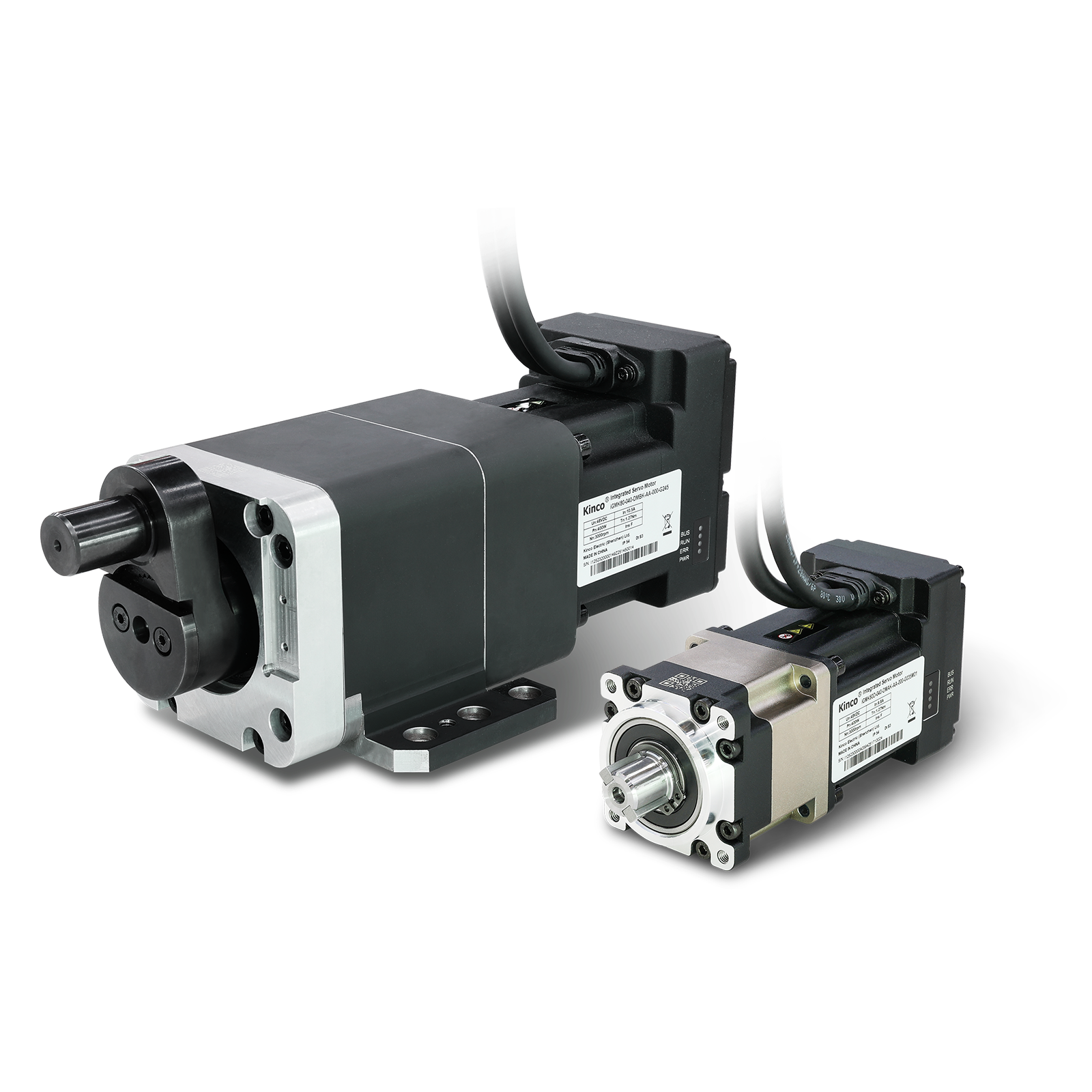
The servo motor closes that gap. Our SMH series AC servo motors cover power ratings from 50 W to 7.5 kW, with flange sizes from 60 mm to 180 mm. The SMK series DC servo motors, available in 48 V and 96 V platforms, address mobile applications like AGVs where the 96 V system delivers higher power at lower current.
The performance difference shows up in three specific areas.
First, speed range. Servo motors maintain rated torque across a wide speed band — typically up to 3,000 rpm and beyond. This makes them suitable for high-speed pick-and-place, CNC machining, and laser cutting applications where throughput depends on rapid traversal.
Second, dynamic response. The FD1X5S fifth-generation low-voltage servo drive, for example, incorporates an adaptive notch filter and S-curve acceleration technology to suppress resonance and noise. The auto-tuning algorithm adjusts parameters to match the connected motor, reducing setup time while delivering smooth operation under variable loads.
Third, overload capacity. Servo motors provide short-term overload torque for acceleration and load surges. This capability matters in applications with intermittent high-torque demands — robotic joints, AGV drivetrains, and high-inertia loads that require aggressive acceleration.
The cost is higher. The system is more complex. But for applications where speed, precision, and dynamic response are non-negotiable, the servo system delivers what a stepper cannot.
The Framework That Guides the Decision
Rather than comparing specifications in isolation, evaluate your application across three dimensions.
Dimension one: operating speed. If your continuous operating speed stays below 800 rpm, a stepper system is viable. Above that threshold, servo performance becomes increasingly advantageous. Check the torque-speed curve for the specific stepper model you are considering — the published holding torque is not the torque available at your operating speed.
Dimension two: duty cycle and starts-stops. Servo systems excel in applications with frequent acceleration and deceleration. The FD1X5S supports power output from 50 W to 3,000 W with 24–60 VDC input, making it suitable for high-cycle applications like packaging machinery and automated assembly. Stepper systems, while reliable, generate more heat during sustained high-speed operation and may require additional cooling or derating.
Dimension three: control architecture. Pulse-direction control works for both stepper and servo systems. But if your machine uses fieldbus communication — EtherCAT, Profinet, CANopen — the available options differ. The FM series stepper drives support CANopen and Modbus. The FD1X5S servo drives support CANopen, Modbus RTU, EtherCAT, and Profinet. Evaluate what your controller speaks before choosing the drive.
The decision also involves practical installation factors. Our stepper motors use standard NEMA flange dimensions, simplifying mechanical integration. Servo motors require encoder cabling and feedback wiring, adding installation steps but enabling diagnostic capabilities that steppers lack.
The choice between stepper and servo is a trade-off, not a hierarchy. Stepper systems deliver cost-effective, reliable positioning for predictable low-to-medium speed applications. Servo systems provide the speed, precision, and dynamic response that demanding applications require.
We design both because both have valid places in industrial automation solutions. The CM and FM series stepper drives serve applications where simplicity and cost control drive the specification. The FD1X5S and SMH/SMK servo systems address applications where performance justifies the investment.
The question is not which motor is superior. The question is which motor fits your machine's actual operating profile. Answer that question honestly, and the selection becomes clear.


