


An AGV that cannot move reliably is not an AGV — it is a stationary problem. And the single component that determines whether that vehicle moves, stops, turns, and carries its rated load day after day is the AGV drive wheel. It is the final link in the motion control chain, the point where motor torque becomes physical traction, and where design compromises show up first in the field.
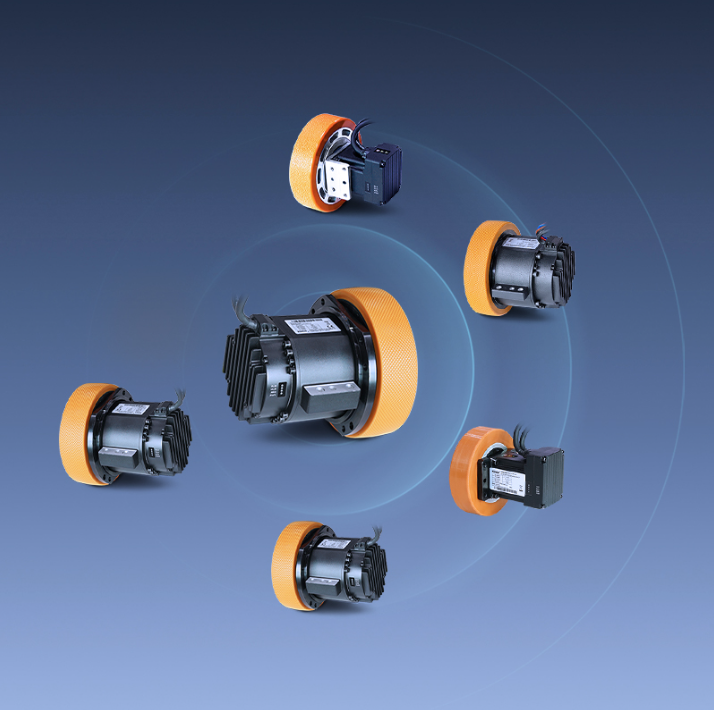
For AGV manufacturers, this makes the drive wheel far more than a supporting component. It is a critical motion module that directly affects vehicle performance, efficiency, and reliability. This is why Kinco Automation has developed integrated AGV drive wheel solutions that bring motion control, transmission, and traction together in a single compact assembly.
Yet drive wheels are often treated as an afterthought — selected late in the design process, specified by diameter and little else. That approach fails to account for what the wheel actually does. Let us examine why this component deserves far more attention than it typically receives.
Where Power Meets the Floor
The AGV drive wheel is the power transmission interface between the vehicle and the ground. The motor generates torque. The drive electronics condition that torque. But until it reaches the wheel's contact patch, none of that energy accomplishes anything useful. The wheel converts rotational energy into linear motion, and the quality of that conversion determines the vehicle's acceleration, deceleration, grade-climbing ability, and positioning accuracy.
In differential drive configurations — the most common motion solution for small and medium-load AGVs — the left and right drive wheels control both steering and movement through speed differences. This means each AGV drive wheel carries dual responsibility: it must deliver propulsive force while also enabling directional control. A wheel that slips, wears unevenly, or responds sluggishly compromises both functions simultaneously.
What a Drive Wheel Must Deliver
The performance requirements for AGV wheels are more demanding than they appear.
Load capacity comes first. An AGV drive wheel must support the vehicle's weight plus its payload, often in a compact envelope. For a two-wheel-drive configuration, each drive wheel may need to handle half the total vehicle weight. In heavy-load applications, per-wheel radial loads can exceed 1,800 kg.
Traction is equally critical. Without sufficient grip, the wheel slips during acceleration or on inclines, causing navigation errors and position drift. The wheel's tread material and contact geometry determine traction. Polyurethane treads, for example, deliver strong traction without overloading motors and reduce rolling resistance to conserve battery energy.
Durability matters because AGVs operate continuously. The wheel must withstand repeated starts and stops, tight turning maneuvers, and stationary steering — all of which accelerate tread wear.
Energy efficiency is a non-negotiable requirement in battery-powered systems. Low rolling resistance and low-friction turning directly extend operating time between charges. A wheel with high rolling resistance wastes energy as heat, reducing the vehicle's effective range and increasing battery costs over the vehicle's lifetime.
The Integration Shift
Traditional AGV drive systems separate the motor, gearbox, drive electronics, and wheel into discrete components connected by cables and mechanical couplings. This approach introduces multiple failure points: wiring that can loosen, couplings that can wear, and alignment issues that reduce efficiency. It also consumes substantial chassis space — space that could otherwise accommodate batteries, controllers, or payload.
The industry has responded with integrated drive wheel solutions that combine these elements into a single assembly. The iWMC integrates the servo drive, servo motor, planetary gearbox, and polyurethane wheel into one compact assembly, with brake options available on selected models.
This approach eliminates complex wiring, reduces assembly labor, and minimizes footprint. The integrated design also improves system reliability by removing the interconnection points where traditional systems most often fail.
The benefits are measurable. Integrated designs can save more than 35 percent of chassis space and cut installation time by 50 percent. For a 600 kg load-class AGV, the shift to an integrated drive wheel solution reduced installation hours by over 80 percent while maintaining the same performance specifications. These are not marginal improvements — they are fundamental changes to how AGVs are designed and built.
Beyond the Wheel
The choice of AGV wheels affects more than mobility. It influences total cost of ownership through maintenance intervals, energy consumption, and component lifespan. A wheel that wears prematurely requires replacement, which means downtime and labor. A wheel with high rolling resistance increases energy costs over the vehicle's entire operating life. A wheel that lacks sufficient traction causes positioning errors that degrade system throughput.
For vehicle manufacturers, the drive wheel also affects design flexibility. Integrated solutions support modular chassis architectures, allowing the same drive wheel specification to serve multiple vehicle models. This reduces inventory complexity and accelerates new product development.
The trend toward integration continues. The Kinco iWMC series now covers load specifications from 600 kg to 1 ton and beyond, with additional models in development for 50 kg, 300 kg, and 1.5 ton applications. Each new specification extends the same principle: a single, reliable component that delivers power, traction, and control without the complexity of separate subsystems.
The AGV drive wheel is not a commodity component. It is the point where design decisions become physical performance. For AGV manufacturers, choosing an integrated motion solution can influence not only how a vehicle moves, but also how efficiently it is assembled, maintained, and scaled across different vehicle platforms.
Kinco's iWMC series reflects this approach by bringing servo control, motor power, precision transmission, and traction together in a single drive wheel. The result is a motion architecture designed to reduce complexity while delivering the reliability, efficiency, and control that modern AGVs require.
Choose the drive wheel wisely, and the vehicle gains a stronger foundation for reliable operation. Choose poorly, and every other component's performance can be compromised. That is why the drive wheel matters — and why the right integrated solution can make a difference far beyond the wheel itself.


