


Robotics drive systems have changed significantly over the past few years. The old approach — sourcing separate motors, drivers, gearboxes, and wheels, then wiring them together on a chassis — is giving way to something more integrated.
The difference is not just about saving space. It is about how these systems perform, how reliably they run, and how quickly they can be deployed.
Here are five features that define what a modern robotics drive system should deliver.
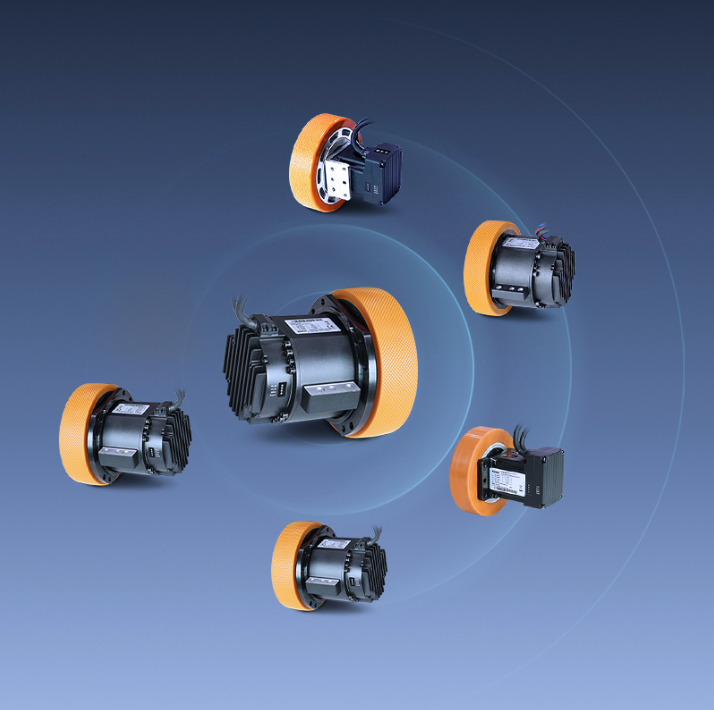
Integration That Eliminates Complexity
The most visible shift in robotics drive systems is the move toward fully integrated assemblies. A conventional setup requires engineers to select, mount, and wire each component individually. That process introduces multiple points of failure, consumes significant engineering hours, and leaves plenty of room for inconsistent build quality.
An integrated AGV drive wheel changes that equation entirely. Our iWMC series, for example, combines servo drive, servo motor, high-precision planetary gearbox, and wear-resistant polyurethane tread into a single unit.
This four-in-one architecture directly addresses the drawbacks of discrete solutions: complicated wiring, labor-intensive assembly, excessive footprint, and inconsistent system reliability. For mobile robot developers, the benefit is immediate — fewer components to specify, fewer cables to route, and fewer assembly steps per vehicle.
The impact on installation space is substantial. An integrated module saves over 35% of the space that walking driver components would otherwise occupy. For AGVs and AMRs operating in tight warehouse aisles or constrained chassis layouts, that space saving translates directly into more design flexibility and better vehicle maneuverability.
Power Density That Handles Real-World Demands
A robotics drive system is only as good as its ability to move weight under real operating conditions. Specifications on paper matter less than how the system performs when the vehicle is fully loaded, climbing a ramp, or navigating uneven floors.
One feature that separates modern robotics drive systems from older designs is overload capacity. The iWMC integrated servo wheel module delivers three times overload capacity, enabled by a high slot-fill rate motor design that produces large overall output torque density.
This means faster full-load starting speed and stronger climbing and obstacle-crossing capability. For a logistics robot carrying heavy payloads through a facility with ramps or dock thresholds, that extra torque margin is not a luxury — it is a requirement for consistent operation.
The torque output scales across load classes. The iWMC family covers applications from 50kg to 2 tons, with rated torque ranging from 3.6 N·m to 54 N·m and peak torque reaching up to 150 N·m.
This range allows system integrators to use a consistent drive architecture across different robot platforms, reducing the need to re-engineer the motion system for each new payload class.
Intelligence Embedded at the Drive Level
Modern robotics drive systems are not just mechanical assemblies — they are intelligent nodes in a networked control architecture. The ability to communicate, monitor, and diagnose is becoming as important as the ability to move.
A well-designed robotics drive system supports standard fieldbus communication. The iWMC series operates as a standard CAN slave device that strictly follows the CANopen 2.0A/B protocol.
Any host computer that supports this protocol can communicate with the servo wheel, enabling centralized control and real-time status monitoring. For multi-vehicle fleets or complex material handling workflows, this communication capability is essential for coordinated motion and system-level optimization.
Beyond communication, onboard intelligence includes features that protect the system and simplify troubleshooting. A built-in temperature sensor monitors the internal temperature of the servo wheel, providing early warning before conditions become critical.
This proactive approach to thermal management helps prevent unexpected downtime and extends component life. The RS485 debug port, supporting baud rates up to 115.2 Kbps, allows engineers to diagnose and tune the system with nothing more than a cable.
Durability Engineered for Continuous Operation
Robotics drive systems in logistics and manufacturing environments run for hours on end, often in challenging conditions. Durability is not an abstract specification — it determines how often the system needs maintenance, how long it lasts, and whether it can survive the environment it operates in.
Several design choices contribute to long-term reliability. The IP54 protection level provides resistance to dust and water ingress, which is critical for AGVs operating in warehouses where floor debris and moisture are common. The polyurethane tread material, available in hardness ratings from 73A to 93A±2, offers wear resistance that maintains traction over thousands of operating hours.
Thermal performance is another durability factor. Systems that run hot experience accelerated wear on bearings, reduced motor efficiency, and shorter overall lifespan. The iWMC series uses natural cooling supplemented by body-assisted cooling, with an operating temperature range of -20°C to +40°C.
The design also incorporates an external braking resistor option for applications with frequent starting and stopping, managing the thermal load that comes with rapid acceleration and deceleration cycles.
Deployment Designed for Speed
The efficiency of a robotics drive system is measured not just in how it moves, but in how quickly it can be put into service. Deployment time, commissioning effort, and serviceability all affect the total cost of ownership.
An integrated design simplifies installation. The bracket design ensures higher installation accuracy and minimizes external cables, which improves vehicle reliability and stability. Screw fastening allows for quick mounting, enabling immediate productivity gains while saving time and reducing costs. For manufacturers producing robots in volume, these time savings add up quickly.
Our Kinco iWMC series offers two installation methods — bracket mounting for 600kg-class applications and bracket-plus-flange mounting for 1T to 2T heavy-load configurations. This flexibility allows the same drive system to accommodate different chassis structures without requiring custom mounting solutions.
Certifications also play a role in deployment speed. The series carries CE and UL certifications, reducing the regulatory barriers that can delay market entry for equipment manufacturers. When a robotics drive system arrives pre-certified, it removes one more variable from the integration timeline.
The Shift Toward Integrated Drive Systems
The features that define modern robotics drive systems — integration, power density, onboard intelligence, durability, and deployability — are not independent attributes. They work together. Integration makes space for more payload. Power density enables faster throughput. Intelligence enables better coordination. Durability reduces maintenance. Deployability gets robots into the field faster.
For system designers and integrators, the question is no longer whether to adopt integrated robotics drive systems. The question is which integrated solution best matches the specific demands of the application. The answer starts with understanding these five features and how they translate into real-world performance.


